


At The Water’s Edge
Rivers have been an integral part of mankind’s development since the dawn of time.
Besides providing a source of food, it also facilitates agriculture and transportation, thus allowing trade and cultural exchanges to flourish.
Many major civilisations throughout history, as well as prominent cities around the world today, started with a river as its focal point. Over time, small settlements became villages, then townships, and subsequently, urban sprawls.
But the rise of modern industry, especially in developed nations, has gradually diminished the interactions between man and these flowing bodies of water and not many give a second thought about what is happening to them.
One man who seeks to change that is Kuala Lumpur-based photographer Chong Kok Choon, better known as KC, who fears the continued pollution and neglect of one of nature’s greatest gifts could have ultimately have adverse impacts on humanity.
Through his month-long Sacred Rivers solo exhibition at the Hin Bus Depot in George Town, Penang, he hopes to show how rivers are intrinsically linked to everyday life, and what people stand to lose if they do not respect and treat them well.

Photographer KC Chong posing with one of his favourite pieces, titled Sacred Rivers VI, which depicts the crowded conditions in Kolkata’s Mullik Ghat flower market in India.
The 34 featured images chronicle the daily routines of locals living around the waterways of India and Bangladesh – specifically in cities like Kolkata, Varanasi, Mumbai and Goa in the former, as well as Dhaka in the latter.
“For the Indian community, a river is not only important civically, but more so spiritually. Their very lives spring from it, and every birth, coming of age, sickness or death are celebrated or mourned by riverbanks,” says Chong at the exhibition’s opening last Saturday.
“It is also the site of many age-old traditions, still preserved and practiced to this day. Daily routines like prayers, bathing and laundry, not to mention special festivals and rituals, are carried out at the water.
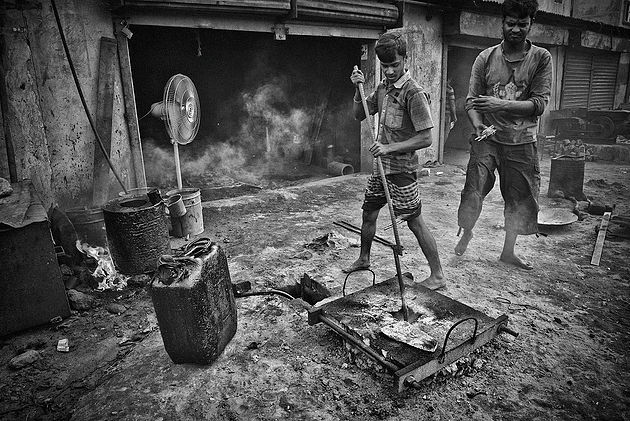
“In contrast, the Bangladeshis see rivers as a crucial to economic development. These teem with commercial activities, from transportation and shipbuilding, to textiles and dyeing industries.
“Their waterways are busy with an endless stream of ferries, sailboats and sampans. While it’s a boon economically, this has also contributed to serious environmental consequences like major floods due to inefficient drainage systems.”
The 40-year-old photographer also warns of rampant pollution and environmental degradation threatening these rivers.
“Water can be soft and nurturing, but with enough force it can also be destructive. It is a double-edged sword that man has yet to learn how to wield. I hope we will learn how to better care for the gift Mother Nature has provided us with. Rivers bring people together, but if we keep poisoning them, one day they will die. And that cannot be good for us,”

His black and white photographs are divided into four series, the titular Sacred Rivers, alongside Kids, Stone Breakers and Tuk Tuks – all taken during his repeated visits to both countries between 2011 and 2014.
Each time, he would stay for around two weeks, and venture around the bustling streets from dawn to dusk photographing the myriad of engaging subjects on display, with his doting wife in tow.
“One thing that hits you is the heat, noise, and sheer number of people. Locals live their lives mostly in the public eye, and everything seems to be on display for everyone to see,” recalls Chong.
“As such, they’re rather accepting of visitors and don’t mind being photographed. This allowed me to take photos that feel natural and have an almost cinematic quality.”
Doing most of his shooting along rivers or in neighbourhoods by the banks, there were many eye-opening sights – from boatmen whose vessels were not only a source of income but also their homes, to the sick and old people loitering around riverbanks waiting for their time.
“In Indian culture, when one dies, they would like the ashes of a body after cremation to be scattered on the river. For every life that springs from those waters, will eventually return to it,” he explains.
Chong also observes how everything was done with manual labour, which makes one like him better appreciate the blessings in life, especially when compared with the struggles others in various parts of the world have to go through just to survive.
The exhibition is Chong’s second solo, following an earlier one in Kuala Lumpur. The fine arts graduate from the Malaysian Institute of Art had also participated in several group exhibitions around Penang and the Klang Valley, previously.
Formerly working in the publication and graphics industry, he picked up photography in 2011 and now runs his own studio.

No Comments